
TEST PROCESS FOR ELECTRIC VEHICLE CHARGING STATIONS (EV CHARGERS)
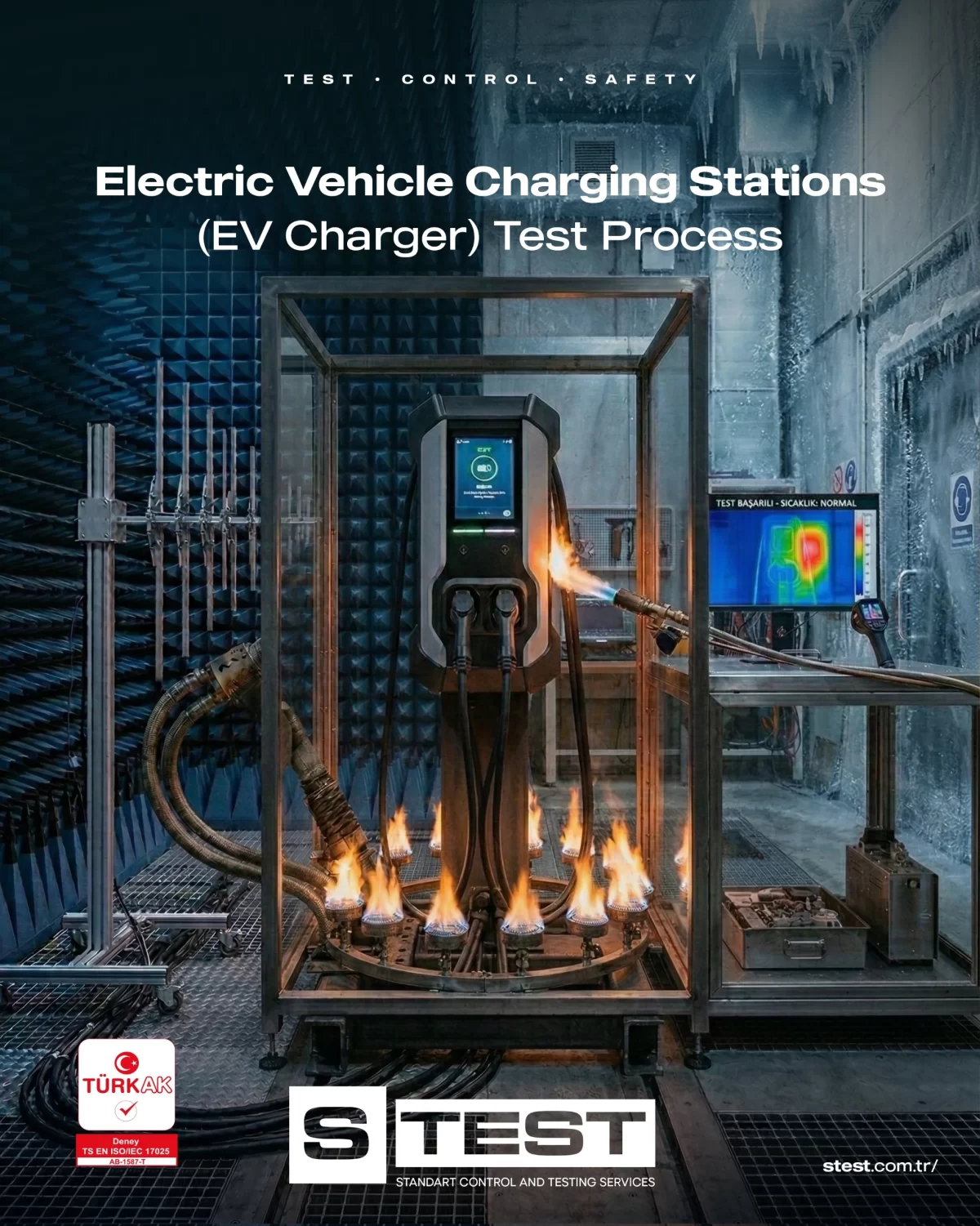
Electric Vehicle Charging Stations (EV Chargers) are critical electrical equipment operating at high power levels and interacting directly with users. Especially in AC and high-power DC charging systems, electrical safety, electromagnetic compatibility, and thermal performance parameters are of paramount imp
In order for an EV Charger to be placed on the market, its technical compliance must be assessed within the scope of European Union legislation. This process is primarily conducted under:
Low Voltage Directive 2014/35/EU (LVD)
Electromagnetic Compatibility Directive 2014/30/EU (EMC)
EV Charger Testing Under the LVD
The LVD regulates the safety of equipment operating within the voltage ranges of 50–1000 V AC and 75–1500 V DC. EV Chargers fall within this scope.
The objective is to ensure that the product:
Is safe against electric shock,
Does not create overheating or fire risks,
Is mechanically and structurally safe by design,
Does not pose hazards under reasonably foreseeable fault conditions.
The main standards commonly applied to EV Chargers include:
EN IEC 61851-1 – Electric vehicle conductive charging systems – General requirements
EN IEC 61851-21-2 – EMC requirements for charging equipment
EN IEC 62196 series – Requirements for plugs, socket-outlets, and connectors
Main Evaluations Performed Within the Scope of LVD Testing
✔ Insulation resistance measurements
✔ Dielectric strength (Hipot) tests
✔ Protective earth continuity
✔ Leakage current and touch voltage measurements
✔ Temperature rise and thermal endurance tests
✔ IP protection class verification
Tests are performed under both nominal operating conditions and limit conditions. Particularly in high-power DC chargers, thermal behavior and insulation coordination are of critical importance.
EV Charger Testing Within the Scope of EMC
Due to the power electronics they contain (IGBTs, SiC modules, switched-mode power supplies, etc.), EV Chargers have the potential to generate electromagnetic interference.
The objectives of EMC testing are to ensure:
The device does not disturb surrounding equipment (Emission),
The device maintains functionality under external electromagnetic influences (Immunity).
1️⃣ Emission Tests
Conducted Emission
Radiated Emission
Harmonic current and flicker assessments
2️⃣ Immunity Tests
Electrostatic Discharge (ESD)
Electrical Fast Transients (EFT / Burst)
Surge
Conducted and radiated RF immunity tests
Voltage dips and short interruptions
Test configurations are established by considering grid connections, control ports, and communication interfaces (Ethernet, RS485, CAN, etc.).
Importance of Load Conditions
One of the most critical aspects of the testing process for high-power EV Chargers is load simulation.
During testing:
Resistive load banks,
Regenerative DC load systems,
Programmable electronic loads
are used to simulate different operating scenarios of the device.
Especially for DC fast charging stations:
Continuous operation at maximum current,
Partial load scenarios,
Dynamic load transitions
are of great importance in terms of test accuracy.
Technical File and Certification Process
Upon completion of testing activities, the manufacturer prepares a Technical File. This file serves as the primary reference demonstrating the product’s compliance with the applicable directives.
The Technical File must include:
Product description and technical specifications
Electrical schematics and block diagrams
Risk analysis (in accordance with EN ISO 12100 methodology)
List of applied standards
LVD and EMC test reports
User manual and labeling information
EU Declaration of Conformity
The documentation must be retained for a minimum period of 10 years.
The testing process for electric vehicle charging stations is not merely a laboratory activity; it is a strategic process in terms of product safety, brand reputation, and regulatory compliance.
Particularly for high-power AC and DC charging systems:
Electrical safety
Electromagnetic compatibility
Thermal performance
Proper technical documentation
must be addressed as an integrated whole.
A properly planned testing process ensures reliable field performance, access to international markets, and a sustainable quality infrastructure.