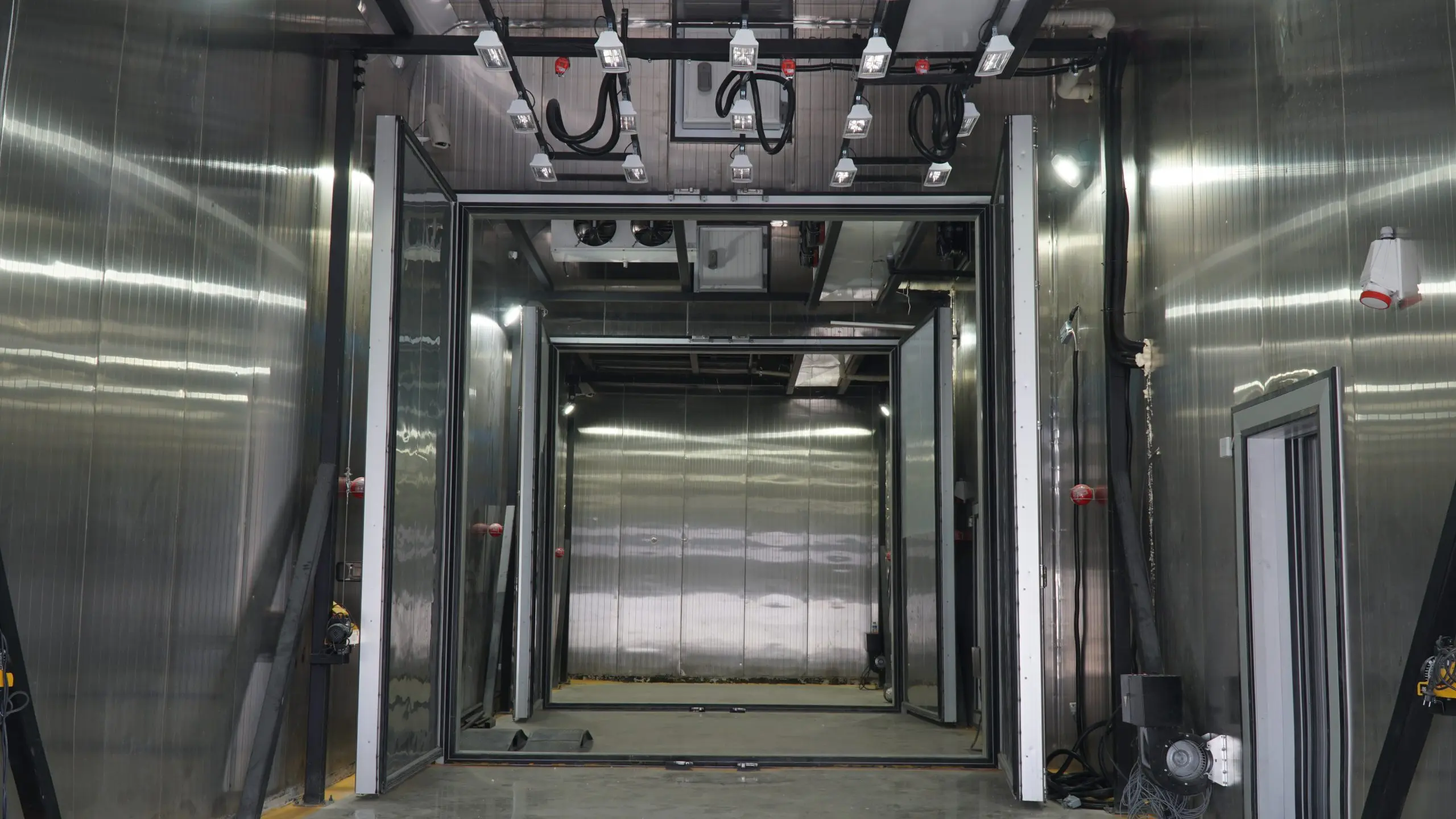
TEMPERATURE CHANGE TEST

TURKAK Accredited Testing and Verification
STEST is accredited by the Turkish Accreditation Institution (TURKAK) and carries out its testing and verification activities in an independent, competent, and impartial manner in compliance with national and international standards.
Temperature Variation Test
The Temperature Variation Test is conducted to observe a specimen’s resistance to rapid changes in ambient temperature. During and/or upon completion of the test,
specimen performance is monitored and any deviations or failures are documented.
Subject to the technical capabilities of the climatic chamber, testing can be performed in accordance with applicable military and civilian standards.
The test is used to determine whether material can withstand sudden changes in the temperature of the surrounding atmosphere without physical damage or
degradation in performance. A rapid transition is typically defined as an air temperature change exceeding 10 °C within one minute. The response of materials
to rapid temperature drops and sudden increases within this one-minute interval is evaluated.
This method is also used to characterize the effects experienced when material or equipment is transferred between climate-controlled environments and extremely
hot outdoor conditions, or between a heated enclosure and cold external conditions in low-temperature regions.
Temperature transients may lead to cracking or embrittlement of plastics, binding issues in moving parts, fractures caused by differential expansion of dissimilar
materials, bond failures in integrated circuits, or electronic/mechanical malfunctions due to rapid water formation or icing.
RTCA DO-160G / Section 5.0 defines a four-variation test procedure. In each of the extreme temperature conditions, a constant temperature is maintained, as the
temperature transition itself may be more dominant than other thermal effects in many cases.
Objective Goal
- To evaluate the specimen’s resistance to rapid temperature transitions.
- To monitor performance during and/or after exposure and document any observed failures.
Test Scope Scope
- Air temperature changes exceeding 10 °C within one minute.
- Assessment of material response to rapid drops and sudden rises within a one-minute interval.
Technical Implementation Process
- To characterize the effects arising from transfers between climate-controlled environments and extreme hot outdoor conditions.
- To characterize the effects arising from transfers between a heated enclosure and cold external conditions in low-temperature regions.
- To apply the four-variation test procedure defined by RTCA DO-160G / Section 5.0.
Application Areas Use
- Risks such as embrittlement/cracking of plastics and binding issues in moving parts.
- Fractures due to differential expansion of dissimilar materials and bond failures in integrated circuits.
- Electronic or mechanical malfunctions resulting from rapid water formation or icing.
STEST performs the Temperature Variation Test in accordance with RTCA DO-160G / Section 5.0 and provides comprehensive reporting and technical documentation.
REQUEST A TEST APPOINTMENT