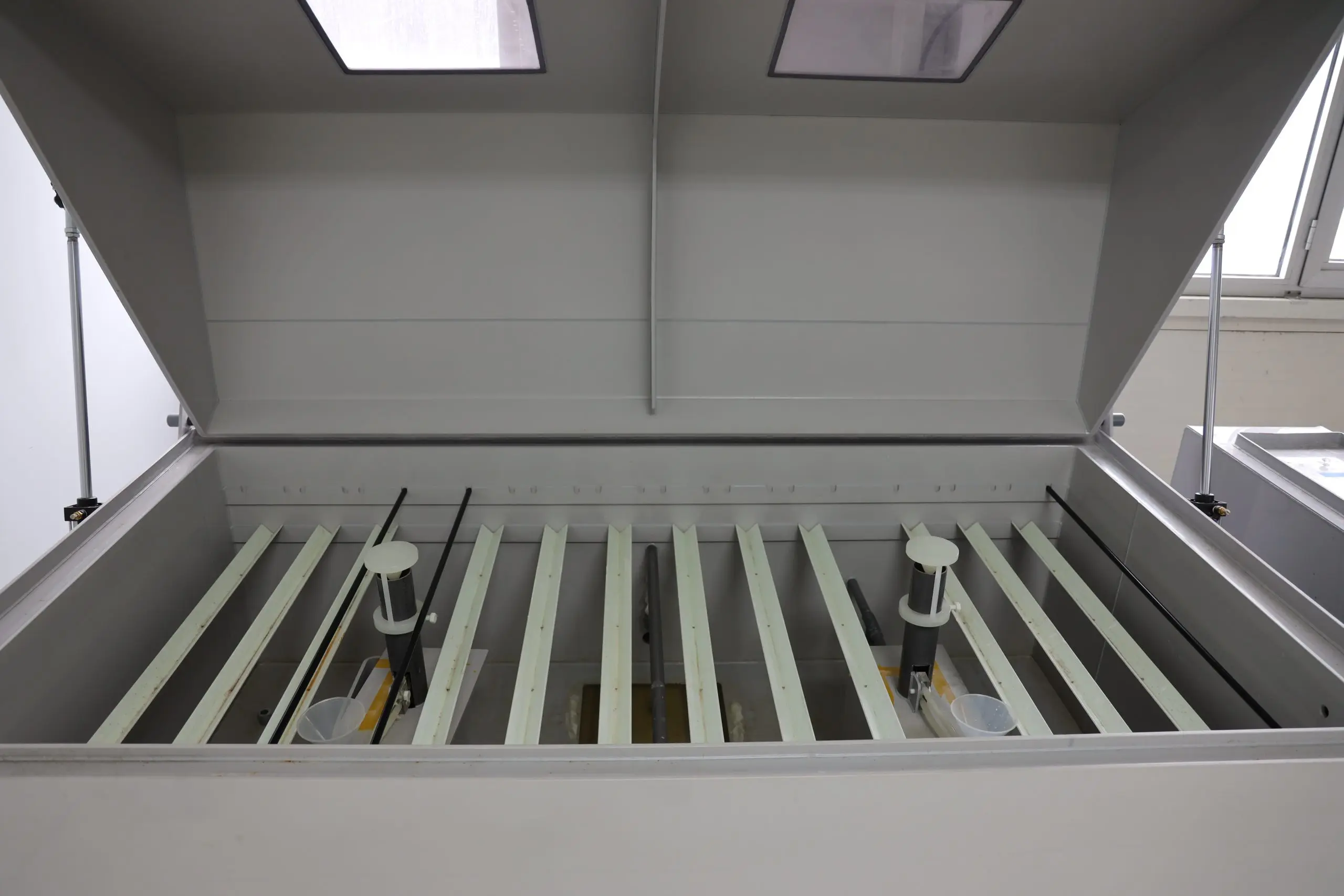
SALT FOG TEST
TURKAK Accredited Testing and Verification
STEST is accredited by the Turkish Accreditation Institution (TURKAK) and carries out its testing and verification activities in an independent, competent, and impartial manner in compliance with national and international standards.
Salt Fog Test
The Salt Fog Test is a critical method used to evaluate the resistance of protective coatings, paints, and materials against saline, humid, and corrosion-inducing environments. This method—particularly important for defense, maritime, automotive, and outdoor equipment—plays a key role in determining product service life and long-term reliability.
Effects and Evaluation Analysis
- The physical, electrical, and chemical effects of salt deposits on materials are observed.
- Electrochemical reactions, stress corrosion, deterioration of insulation materials, and short-circuit risks may be assessed.
- Coating blistering, blockage of moving parts, and corrosion effects driven by pinholes or cracks in coatings are examined.
Standards Compliance and Sequencing Procedure
- Salt Fog Testing is performed in accordance with standards such as MIL-STD-810, RTCA DO-160, IEC, ISO, EN, ETSI, and ASTM.
- Test specimens are generally not reused for other tests; if reuse is required, humidity and fungus tests should be performed prior to the salt fog test.
- Sand and dust tests should be carried out after the salt fog test.
Outcome and Benefits Output
- Corrosion resistance, durability, and long-term performance of products are verified.
- A conformity assessment is provided to support safe use under harsh environmental conditions.
Application Areas Use
- Defense, maritime, automotive, and outdoor equipment
- Protective coatings, paints, and metal/alloy materials
At STEST, we conduct salt fog tests in accordance with applicable standards—primarily MIL-STD-810, RTCA DO-160G, and ASTM B117—and provide detailed evaluation and reporting to verify corrosion resistance and long-term performance.
REQUEST A TEST APPOINTMENT