
WHAT ARE MILITARY TESTS? THE MOST RIGOROUS EXAMINATION OF PRODUCT RELIABILITY
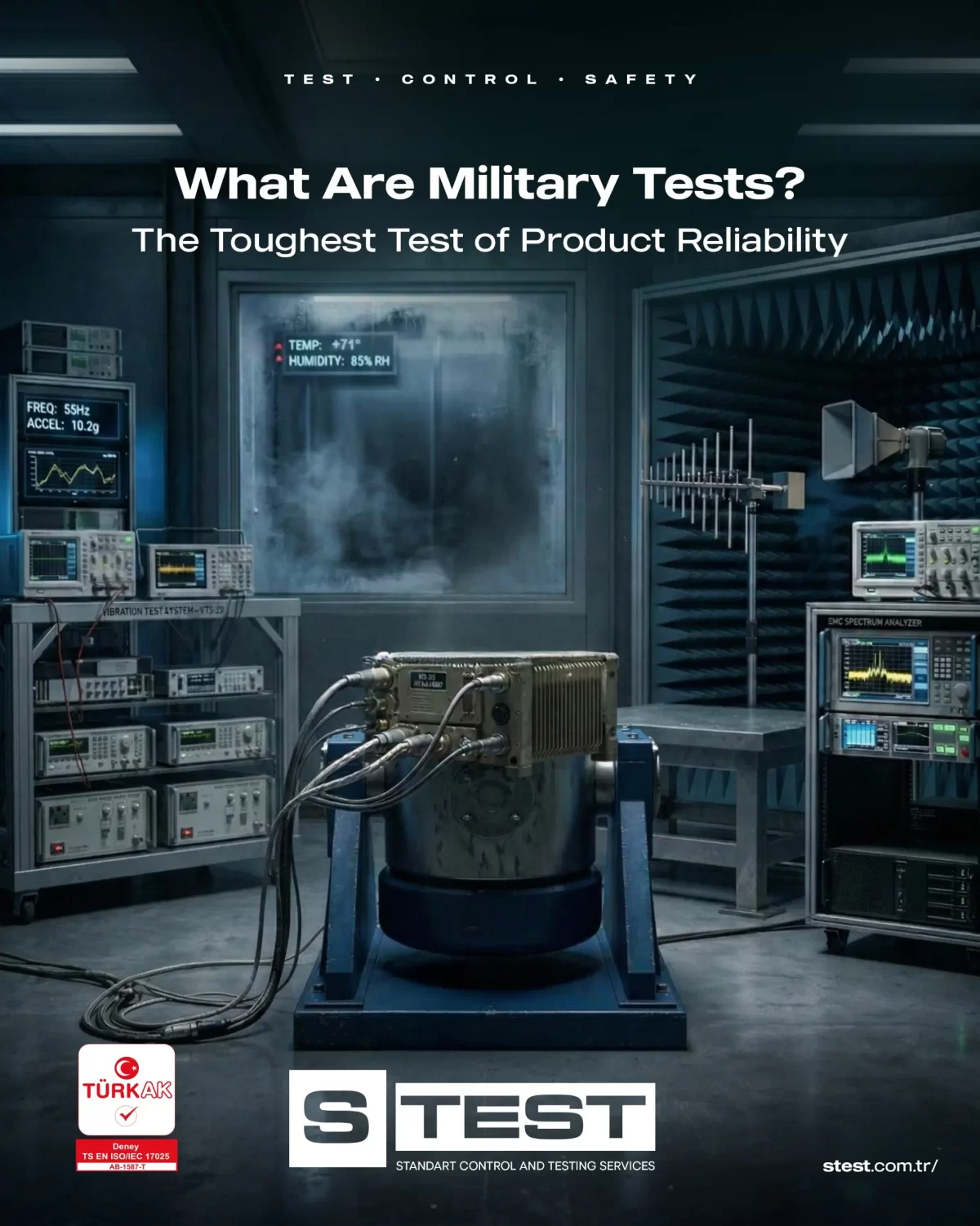
Products used in the defense industry are exposed to far more demanding environmental and mechanical conditions than civilian products. For this reason, compliance with military standards is not only an indicator of quality but also a fundamental requirement for operational safety.
Military testing aims to measure the performance of products under harsh conditions such as vibration, shock, temperature, humidity, dust, water, pressure, and electromagnetic effects.
Why Are Military Tests So Important?
In defense projects, the tolerance for failure is almost zero. A system failure in the field can lead to operational risk, time loss, and significant costs.
Military testing processes:
Verify product reliability
Increase operational lifespan
Document compliance with international military standards
Support acceptance and certification processes
Protect human life
Reduce project risks
Compliance with standards such as MIL-STD, AECTP, and RTCA DO-160 is especially critical for participating in global defense projects.
What Are the Types of Military Tests?
1. Environmental Military Tests
High and low temperature tests
Thermal shock tests
Humidity and altitude tests
Salt fog and corrosion tests
Icing
Dust and sand
2. Mechanical Durability Tests
Vibration tests
Mechanical shock tests
Impact tests
Drop tests
Acceleration tests
These tests are critical for systems used in land, air, and naval platforms.
3. EMI/EMC Military Tests
Electromagnetic interference and compatibility tests ensure that military systems operate safely alongside other equipment.
The Role of Standards in Military Test Processes
Military testing activities are based on internationally recognized standards.
Main references include:
MIL-STD-810 (Environmental Tests)
MIL-STD-461 (EMI/EMC Tests)
AECTP-300 Series
MIL-STD-704
These standards define the test methodology, parameters, and acceptance criteria. As a result, military test results gain international validity.
Reliable Military Testing Services with STEST
STEST performs the military testing services required in defense industry projects in accordance with international standards.
Thanks to its advanced test infrastructure and engineering approach:
Product verification processes are accelerated
Project risks are minimized
Technical acceptance processes are secured
In defense systems, trust begins in the laboratory—not in the field. For this reason, military test planning should be carried out starting from the design phase.