
MIL-STD-461 CRITICAL EMC TESTS: CS101, RE102, AND RS103 (200 V/M) FOR REAL ENVIRONMENTAL AND ELECTROMAGNETIC SURVIVABILITY VALIDATION
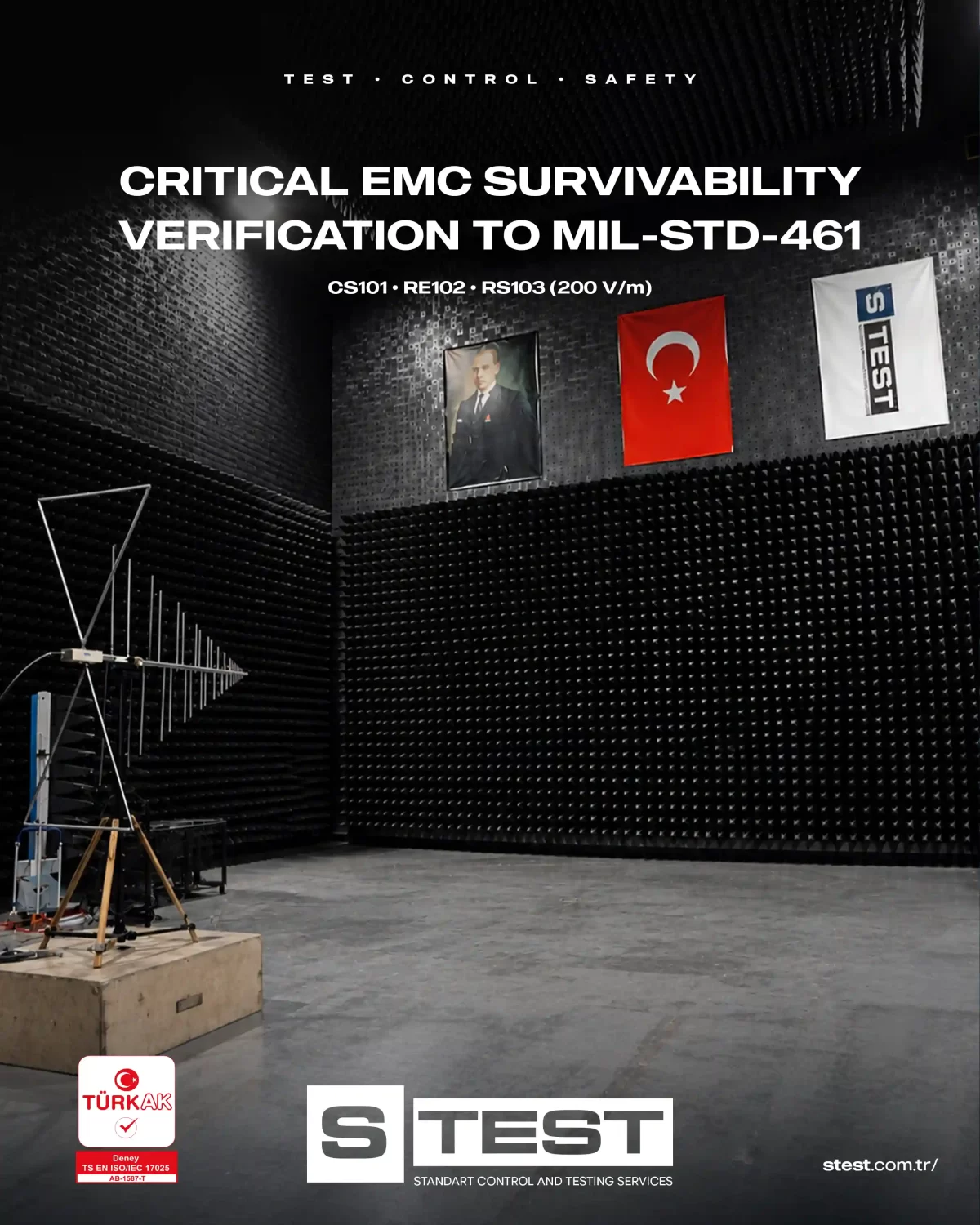
Three critical test methods stand out in determining real operational survivability and electromagnetic robustness: CS101, RE102, and RS103.
CS101 – Verification of Conducted Susceptibility Through Power Lines
CS101 verifies the immunity of equipment against low-frequency conducted disturbances transmitted through power input lines.
During this test, performed within the 30 Hz – 150 kHz frequency range, controlled disturbance signals are injected into the power lines while system performance is monitored in real time.
Weak filtering design or improper grounding architecture may lead to critical failures such as:
→ Control board resets
→ Data loss
→ Unstable system behavior
CS101 is regarded as one of the primary indicators of design quality, particularly in military systems with intensive power electronics architectures.
RE102 – Electromagnetic Discipline Within the Platform
RE102 verifies that the electromagnetic energy radiated by the equipment remains within specified limit values.
Conducted within the 10 kHz – 18 GHz frequency range, this test is performed using:
- Reference ground planes
- Standardized cable configurations
- Calibrated measurement antennas
- Peak and average limit analysis methodologies
Excessive radiation is not merely a limit exceedance; it may result in:
→ Communication interference
→ Loss of sensor accuracy
→ Chain-effect EMI propagation within the platform
Successful RE102 performance is a direct indicator of the engineering maturity and electromagnetic discipline of the system design.
RS103 – Simulation of Real Operational Electromagnetic Environments
RS103 verifies the immunity of equipment against high-frequency electromagnetic fields.
During the test, conducted within the 2 MHz – 18 GHz frequency range, the following conditions and methodologies are applied:
- Semi-anechoic test environment
- Calibrated broadband antennas
- Field uniformity verification
- Performance monitoring under all operational modes
This test represents a critical survivability indicator, particularly for systems operating in proximity to radar platforms and high-power RF sources.
200 V/m: A High-Level Survivability Threshold in EMC Testing
Many laboratories are capable of performing RS103 testing at field strengths of 20–50 V/m.
However, the 200 V/m level represents a realistic simulation of high electromagnetic density military environments.
This level is considered a critical requirement for:
- Military ground platforms
- Radar-adjacent mission systems
- Electronic warfare environments
- High RF density operational scenarios
Why Is 200 V/m Testing Challenging?
Performing tests at this level requires:
- High-power broadband RF amplifier infrastructure
- Stable and verified field generation capability
- Precisely calibrated electric field probes
- Field uniformity validation
- Highly RF-shielded test chambers
Generating 200 V/m is not simply a matter of high power.
It is the combination of engineering accuracy, calibration discipline, and advanced infrastructure investment.
Incorrect field distribution → Incorrect immunity results.
Incorrect immunity results → Operational risk.
200 V/m RS103 Capability in Türkiye
Our capability to perform verification at the 200 V/m level within the scope of RS103 demonstrates that we are one of Türkiye’s strategic EMC infrastructures for defense projects requiring high electromagnetic survivability.
This capability is supported by:
- High-power broadband RF amplification infrastructure
- Semi-anechoic chamber facilities
- Calibrated antenna, probe, and LISN systems
- Field uniformity verification capability
- Large-volume EUT testing capacity
- Technical reporting discipline aligned with defense industry requirements
This infrastructure represents not only a testing service, but also a strategic assurance for systems requiring high electromagnetic survivability in defense projects.
EMC verification is not merely a procedure; it is the operational reflection of system reliability.
MIL-STD-461 verification is not simply a document; it is the technical evidence of mission assurance.
A system successfully verified at the 200 V/m level demonstrates its ability to maintain mission continuity in high RF density operational environments.
EMC is not a “final test”; it is a measure of engineering quality.
And high-level immunity is only achievable through strong infrastructure and precise engineering.