
MEASUREMENT OF PRODUCT DURABILITY THROUGH ENVIRONMENTAL TESTING
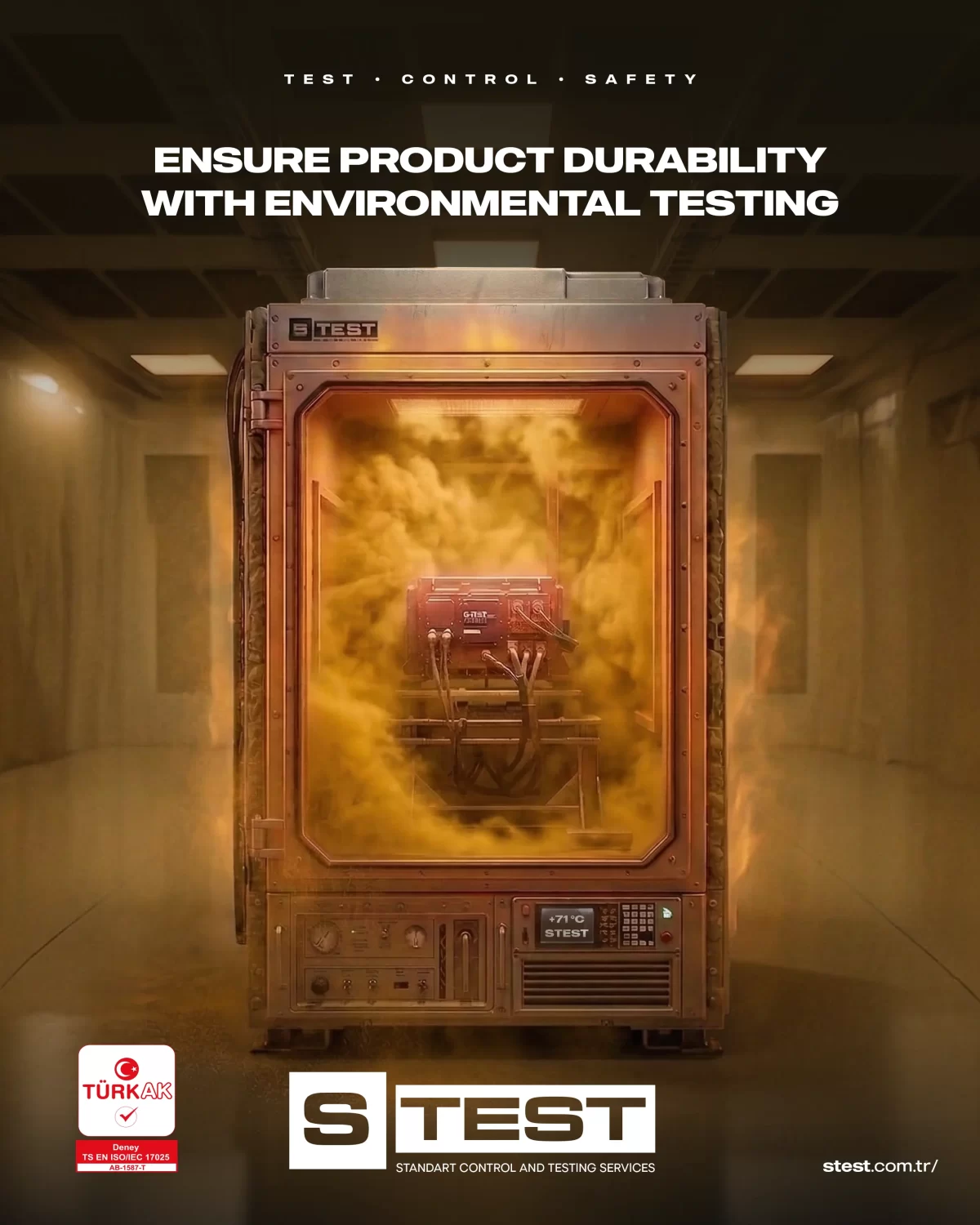
Products used in the defense, aerospace, automotive, and electronics industries are exposed to numerous environmental factors such as temperature variations, humidity, dust, solar radiation, and mechanical stresses. For this reason, environmental testing constitutes a critical verification process to ensure that products operate safely, reliably, and without interruption under real-life field conditions.
As STEST, we provide environmental testing services in accordance with national and international standards through our accredited testing infrastructure. While verifying product durability, we also ensure the reliability of test results and their international validity.
Purpose of Environmental Testing
The primary objectives of environmental testing are:
- To verify product resistance against harsh environmental conditions
- To identify potential failures prior to field deployment
- To enhance product reliability and extend service life
- To document compliance with military and industrial standards
- To ensure operational safety
Through these tests, manufacturers can minimize technical risks and validate system performance before deployment in real-world operational environments.
Environmental Tests Performed within the Scope of STEST
Environmental Tests Performed within the Scope of STEST
High and Low Temperature Tests
Evaluate whether products maintain their functionality under extreme hot and cold environmental conditions. Material structures, electronic components, and mechanical parts are analyzed for temperature-related effects.
Humidity Test
Assesses the potential impact of high relative humidity on products, including corrosion risk, insulation degradation, and possible performance losses
Fungus Test
Determines product resistance to fungal growth. This test is particularly critical for military systems operating in tropical and high-humidity environments.
Immersion Test
Verifies sealing performance and functional integrity when products are exposed to water at specified depths and durations.
Icing Test
Evaluates the effects of ice formation on product surfaces under low temperature and humidity conditions, focusing on functional performance.
Dust and Sand Test
Simulates desert and open-field environments to measure product resistance to dust and sand particles, including sealing capability and mechanical durability.
Thermal Shock Test
Analyzes the effects of rapid temperature changes on products, including potential material cracks, connector integrity, and solder joint reliability.
Vibration Test
Simulates vibration conditions that may occur during transportation or operation to assess structural integrity and mounting durability.
Shock and Impact Tests
Examines the effects of sudden mechanical shocks and impacts on products. These tests are especially critical for military and portable systems.
Acceleration Test
Measures the impact of high acceleration and deceleration forces on product performance and mechanical robustness.
Solar Radiation (Sunlight) Test
Evaluates temperature increase, discoloration, and material degradation caused by prolonged exposure to solar radiation.
Rain Test
Assesses sealing performance and functional operation under rain and water spray conditions.