CE102 TEST
TURKAK Accredited Testing and Verification
STEST is accredited by the Turkish Accreditation Institution (TURKAK) and carries out its testing and verification activities in an independent, competent, and impartial manner in compliance with national and international standards.
CE102 Test (Conducted Emissions on Power Leads, 10 kHz–10 MHz)
The CE102 test is a conducted emissions assessment performed under MIL-STD-461 to evaluate electromagnetic energy coupled onto an equipment’s AC/DC power input leads in the 10 kHz to 10 MHz range. It determines whether noise conducted via the power distribution network could adversely affect other onboard systems, including communications and sensing infrastructure—making CE102 a critical requirement for preserving platform reliability and mission performance.
Purpose of the CE102 Test Objective
- Assess conducted emissions on power input leads in the medium- and high-frequency range.
- Determine whether power-line noise can disturb other systems and the platform communications infrastructure.
- Demonstrate compliance to protect the reliability of communications and sensing functions.
CE102 Test Scope Scope
- Applicable to military equipment with AC and/or DC power input leads.
- Tests are performed under representative normal operating conditions (worst-case modes identified where relevant).
- Frequency range and limit values are defined by the selected MIL-STD-461E/F/G revision and platform category.
- Valid for land, sea, and air platforms; limits may vary depending on the intended electromagnetic environment.
CE102 Test Method Process
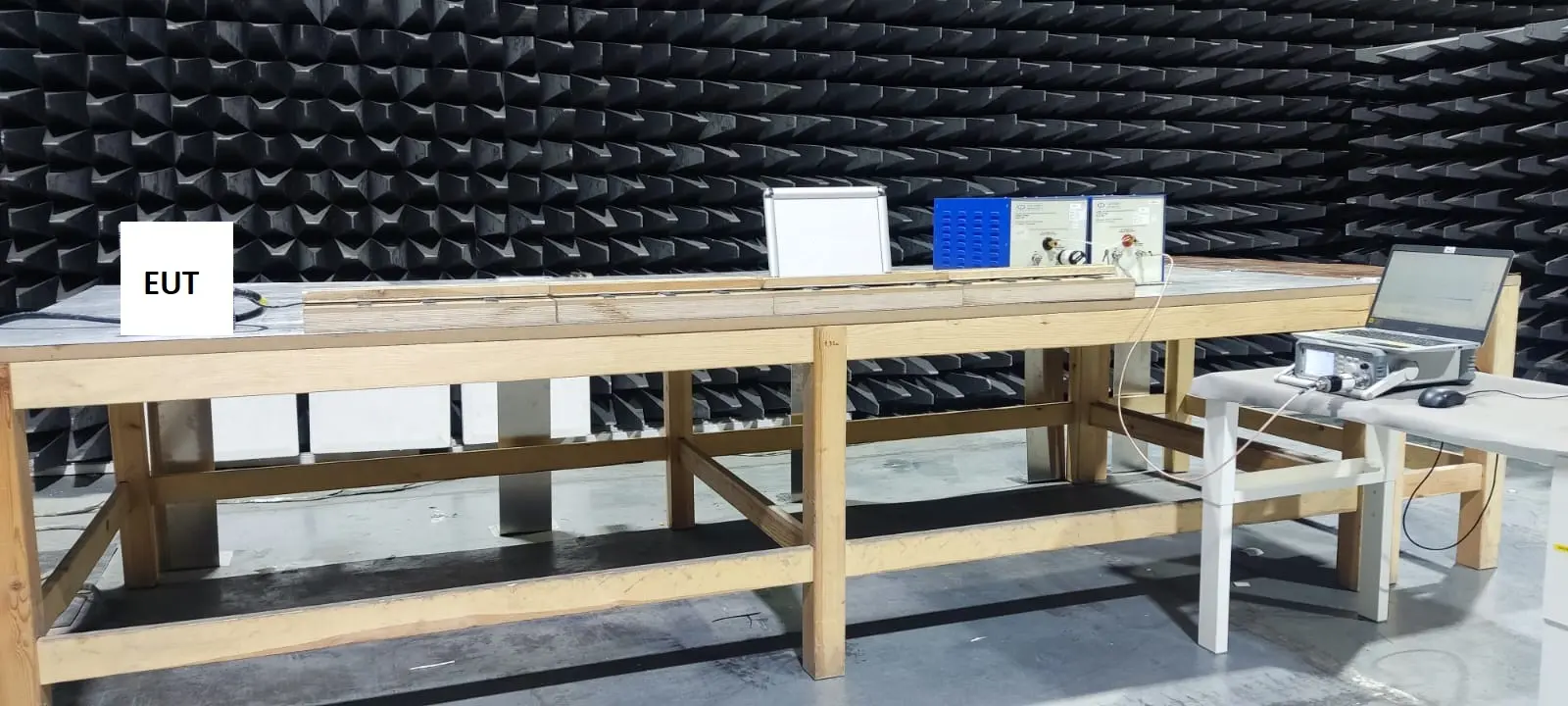
- A LISN (Line Impedance Stabilization Network) is used to control line impedance and provide a stable measurement interface.
- Conducted emission levels are measured using calibrated EMI receivers with the detector and bandwidth settings defined by the standard.
- Results are compared against the applicable MIL-STD-461 limit curves for the targeted platform class.
- The test outcome clearly characterizes power-line noise coupling and supports mitigation actions when required.
Our CE102 Capability and Infrastructure STEST
- CE102 testing is performed in line with MIL-STD-461E / 461F / 461G, based on program and platform requirements.
- Tests are executed using configurations aligned with the standard-defined methodology and instrumentation requirements.
- CE102 measurements are conducted in our TÜRKAK-accredited shielded room in accordance with TS EN ISO/IEC 17025.
STEST performs CE102 conducted emissions testing under MIL-STD-461 using accredited laboratory infrastructure and controlled measurement conditions required by military programs—delivering clear, traceable results and comprehensive reporting.
REQUEST A TEST APPOINTMENT