
WHAT ARE INDUSTRIAL PRODUCT TESTS? HOW ARE PRODUCT PERFORMANCE AND DURABILITY EVALUATED?
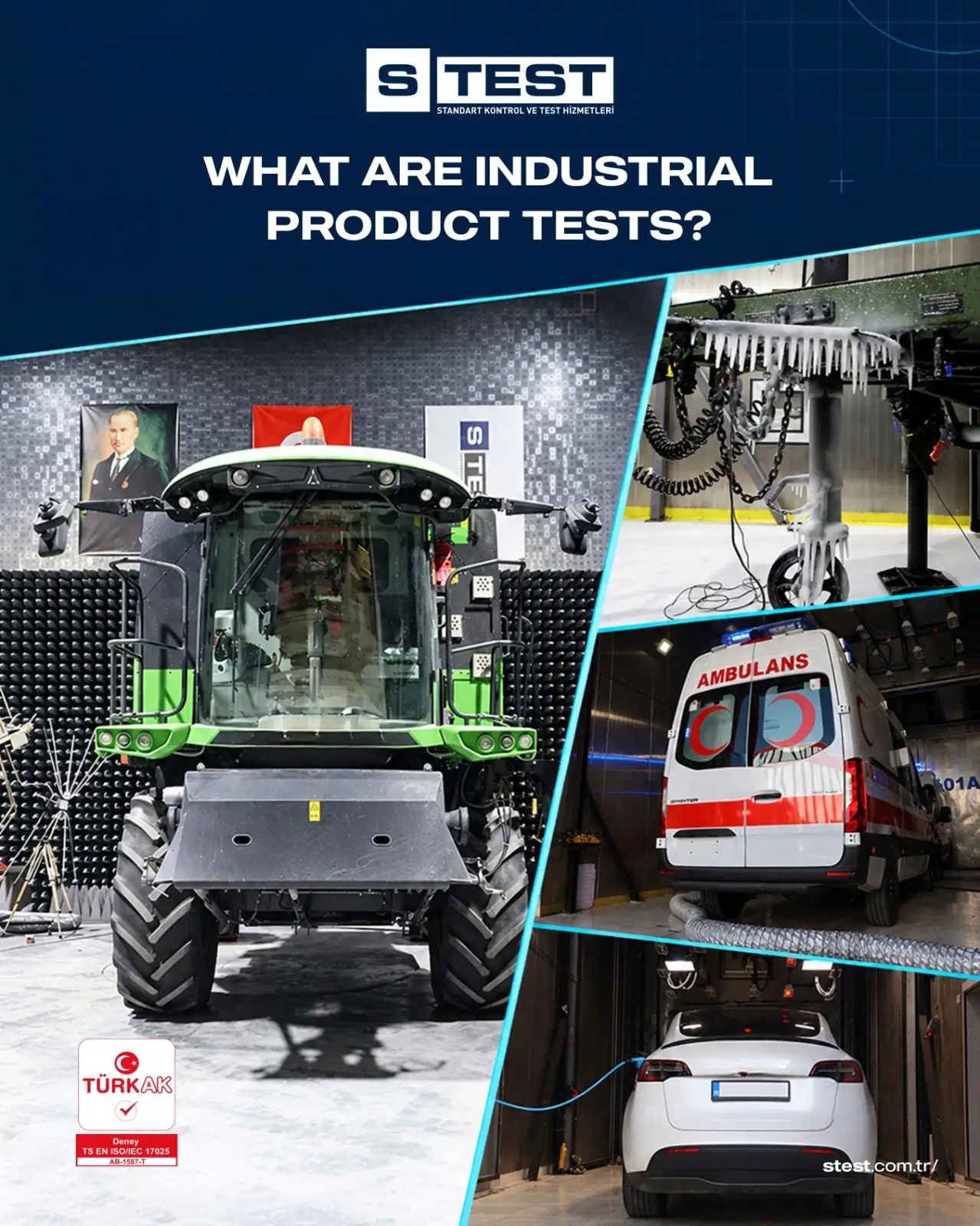
Industrial products may be exposed to various environmental and operating conditions throughout their service life, including temperature fluctuations, humidity, vibration, mechanical shock, dust, water, and electromagnetic effects. A product that performs without issue during the design and prototype stages must be evaluated through controlled and repeatable testing processes to determine whether it can maintain the expected level of performance under real-world operating conditions.
Industrial product testing encompasses technical testing processes conducted to evaluate the performance, durability, and functional behaviour of products under specified operating and environmental conditions. The test programme is developed by considering the product’s intended use, technical specifications, anticipated operating conditions, customer requirements, and applicable standards or test methods.
Product testing conducted for the defence, automotive, aerospace, electronics, energy, machinery, railway, and other critical industrial sectors is an essential part of design verification, product development, pre-production validation, and conformity assessment processes.
Why Are Industrial Product Tests Conducted?
The fact that a product operates successfully in a laboratory or during the prototype stage does not, by itself, guarantee that it will deliver the same performance under field conditions. Particularly for equipment used in critical applications, its behaviour under temperature, humidity, vibration, mechanical shock, electromagnetic effects, and other environmental conditions must be evaluated in advance.
Industrial product testing can help to:
- Identify design weaknesses.
- Detect potential failure points.
- Evaluate the product’s resistance to environmental and mechanical conditions.
- Examine the electromagnetic behaviour of electrical and electronic products.
- Implement the necessary engineering improvements before serial production.
- Provide measurable technical data for product development processes.
- Determine whether the specified test requirements have been met.
Testing processes are therefore used not only to determine whether a product meets a particular test criterion but also to support the improvement of the product design and overall engineering approach.
What Tests Are Applied to Industrial Products?
The same test programme is not applied to every product. Test selection is based on the product’s intended application, technical specifications, target operating conditions, customer requirements, and the applicable standard or test method.
The principal types of industrial product testing include environmental testing, vibration and mechanical shock testing, IP dust and water ingress testing, and EMI/EMC testing.
Environmental Testing
Environmental testing is conducted to evaluate the durability and functional performance of products under the environmental conditions they may encounter during operation, storage, and transportation.
Depending on the product’s intended use, various environmental conditions may be included in the test programme. These may include:
- High-temperature testing
- Low-temperature testing
- Temperature cycling
- Humidity testing
- Thermal shock testing
- Altitude testing
- Combined climatic condition testing
The purpose of environmental testing is not limited to observing whether the product continues to operate. It also enables the effects of environmental conditions on the product’s mechanical structure, electronic components, connections, enclosure, and functions to be evaluated.
Vibration and Mechanical Shock Testing
Products used in vehicles, defence systems, electronic equipment, machinery, and other industrial applications may be exposed to continuous vibration and sudden mechanical shocks during operation or transportation.
Vibration testing is conducted to evaluate a product’s structural integrity and functional performance under specified vibration profiles.
Mechanical shock testing helps assess the product’s behaviour when subjected to sudden acceleration, impact, and similar mechanical effects.
These tests can reveal potential problems in connection points, mechanical parts, electronic components, soldered joints, enclosure structures, and other critical areas.
Where necessary, the test results can provide technical data to support improvements to the product design or assembly methods.
IP Dust and Water Ingress Testing
Enclosure protection is an important design and performance criterion for products used outdoors, in vehicles, or under demanding industrial conditions.
IP testing covers tests used to evaluate the degree of protection provided by electrical equipment enclosures against the ingress of solid foreign objects and water. The classification of IP codes and the associated test methods are defined within IEC 60529.
Different dust and water ingress tests may be conducted depending on the product’s target IP rating. The test results are used to evaluate whether the product enclosure provides the relevant degree of protection under the specified test conditions.
EMI/EMC Testing
Electrical and electronic products may generate electromagnetic emissions during operation while also being exposed to external electromagnetic disturbances.
EMC (Electromagnetic Compatibility) testing helps determine whether a product can operate within a defined electromagnetic environment without generating unacceptable electromagnetic disturbances and while maintaining its intended functionality when exposed to specified electromagnetic effects.
Within the scope of EMI/EMC testing, the product’s emission and immunity characteristics may be examined using various test methods.
Depending on the product and applicable standard, these tests may include:
- Conducted emission testing
- Radiated emission testing
- Electrostatic discharge (ESD) testing
- Radiated immunity testing
- Electrical fast transient/burst testing
- Surge testing
- Conducted RF immunity testing
- Other electromagnetic compatibility tests
The applicable test methods and acceptance criteria are determined according to the product’s intended application and relevant standards.
With its EMI/EMC testing infrastructure, STEST provides testing services for evaluating the electromagnetic compatibility of electrical and electronic products used across various sectors.
How Does Industrial Product Testing Contribute to Product Development?
A failure identified during testing does not necessarily mean that the product development process itself has failed. On the contrary, a problem revealed under controlled test conditions can provide valuable engineering data for improving the product before it is deployed in the field.
For example:
- A connection issue identified during vibration testing may lead to a reassessment of the mechanical design.
- Performance degradation observed during high-temperature testing may provide data for improving thermal management or cooling design.
- Water ingress detected during an IP test may require the enclosure and sealing design to be reassessed.
- An emission or immunity issue identified during EMC testing may support improvements to the electronic design, cabling, or electromagnetic protection approach.
Industrial product testing should therefore be regarded not only as a final-stage product verification activity but also as an important technical tool that supports design and engineering processes.
Why Are Testing Standards Important?
Standards and defined test methods play an important role in establishing test conditions and evaluation criteria for industrial product testing.
Depending on the product’s intended use and target application, IEC, ISO, EN, MIL-STD, and other national or industry-specific standards may be applied.
For example, standards such as the IEC 61000 series may be used for the electromagnetic compatibility of electrical and electronic products, while IEC 60529 may be used to evaluate the degrees of protection provided by enclosures.
However, selecting a single standard may not be sufficient for every product. The following factors should be evaluated together:
- Intended use
- Operating environment
- Mechanical and environmental loads
- Electrical characteristics
- Target market
- Customer requirements
- Applicable regulations and standards
Selecting the correct testing standard and test method helps ensure that the results obtained are technically meaningful, traceable, and comparable.
How Is an Appropriate Industrial Product Test Plan Developed?
A successful testing process begins with the development of an appropriate test plan before the product is placed in the test equipment.
During the initial stage, the product’s intended use and technical requirements are evaluated. The environmental, mechanical, and electromagnetic conditions to which the product may be exposed are then identified, and the applicable tests and test methods are determined accordingly.
The following factors may be considered when preparing a test plan:
- Definition of the product and its intended use
- Identification of technical requirements
- Selection of applicable standards and test methods
- Definition of test conditions and acceptance criteria
- Establishment of the test sequence
- Identification of the performance criteria to be monitored during testing
- Evaluation and reporting of test results
The correct sequencing of tests is also important. Unnecessary or incorrectly planned tests may result in a loss of time and cost, while a properly structured testing programme can provide more meaningful data regarding the product’s technical performance.
The Importance of ISO/IEC 17025 Accreditation in Testing Processes
The technical competence of a testing laboratory and confidence in the results it produces are important aspects of product testing processes.
ISO/IEC 17025 defines the requirements for the competence, impartiality, and consistent operation of testing and calibration laboratories. Accreditation is therefore an important reference in evaluating whether a laboratory is competent to perform testing activities reliably within a defined scope.
STEST serves the environmental, mechanical, and electromagnetic testing needs of various sectors through its testing infrastructure accredited by TÜRKAK within the scope of TS EN ISO/IEC 17025. The current STEST website states that the laboratory has more than 100 accredited testing scopes and testing infrastructure serving different industries.
The scope of accreditation does not cover every test that a laboratory may be capable of performing. It refers specifically to the tests and methods for which the laboratory is accredited. The applicable testing and accreditation scope must therefore be evaluated separately for each project.
Industrial Product Testing with STEST
STEST provides testing services to evaluate the performance of vehicles, systems, equipment, components, and other products used in the defence, automotive, aerospace, electronics, and wider industrial sectors under various environmental, mechanical, and electromagnetic conditions.
Testing activities are conducted under controlled laboratory conditions in accordance with the product’s technical requirements and applicable test methods.
One of the fundamental priorities of STEST’s approach is to ensure that test results are obtained accurately, reliably, and with full traceability. Laboratory competence and impartiality principles established within the ISO/IEC 17025 framework are also an important part of this approach.
You can contact STEST to identify the tests applicable to your product, develop an appropriate test plan, and evaluate the relevant testing scope.
Frequently Asked Questions (FAQ)
What is industrial product testing?
What tests are applied to industrial products?
Depending on the product’s intended application and technical requirements, applicable tests may include temperature, humidity, thermal shock, vibration, mechanical shock, IP dust and water ingress, EMI/EMC, and other environmental or mechanical tests.
The testing programme is determined according to the product requirements and relevant standards or test methods.
Why is industrial product testing important?
What happens if a product fails a test?
Failure to meet a test criterion does not necessarily mean that the product is unsuitable for use under all conditions. The test results must be evaluated together with the applied test method, test conditions, acceptance criteria, and product requirements.
Where necessary, improvements may be made to the design or manufacturing process, after which the product may be retested.