
HOW IS AN ENVIRONMENTAL TESTING PROCESS PLANNED?
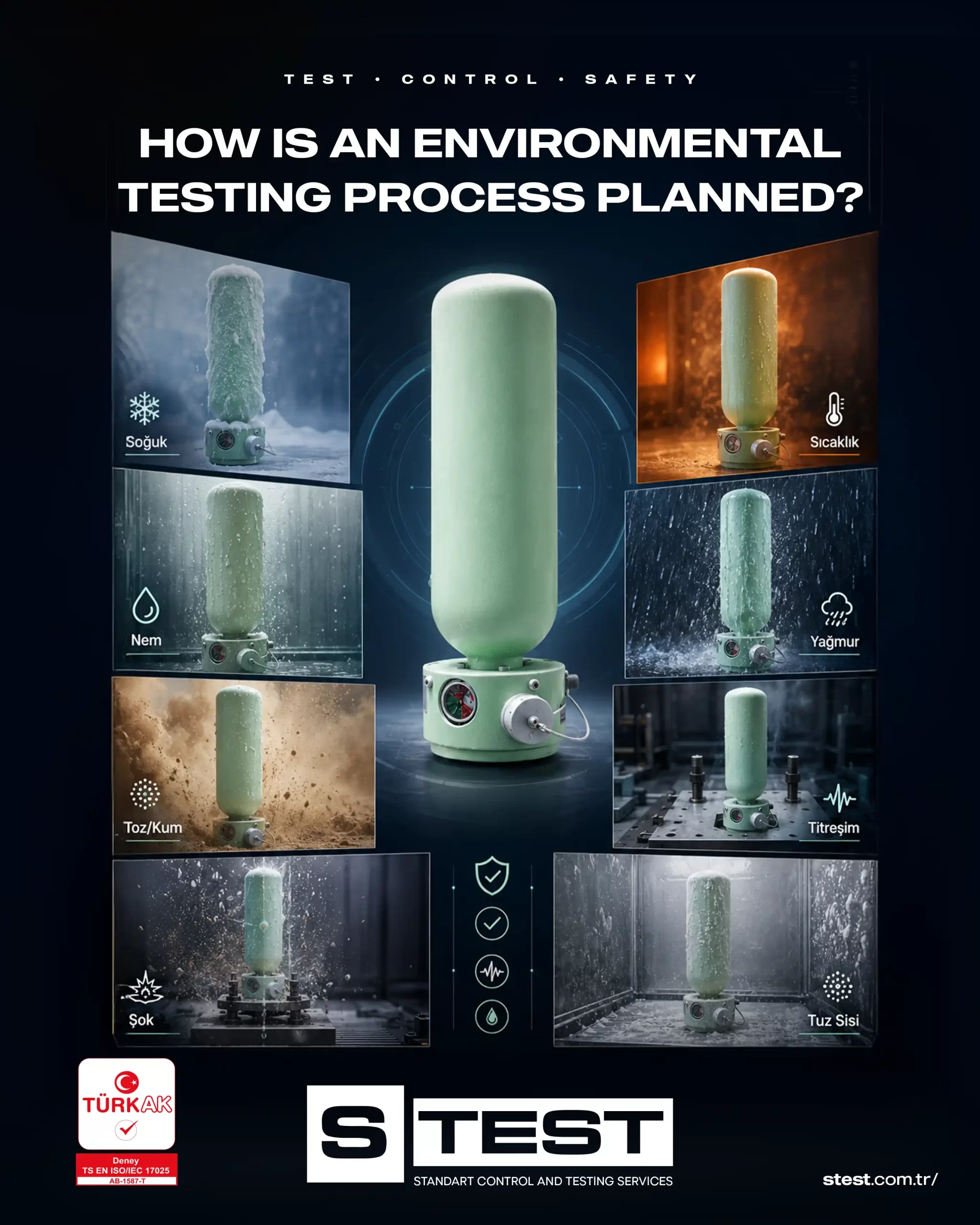
An environmental testing process is planned by identifying the environmental conditions that a product may encounter during operation, transportation, and storage, selecting the appropriate test standards, defining test levels, preparing the test specimen, and establishing acceptance criteria. A properly developed test plan represents actual operating conditions in a laboratory environment and enables the verification of product reliability and durability performance.
To evaluate whether a product is resistant to environmental conditions, simply selecting test equipment or applying a test method specified in a standard is not sufficient. An effective environmental testing process is a comprehensive engineering process that begins with the analysis of the product life cycle and concludes with the technical evaluation of test results.
The product’s application area, operating conditions, transportation method, storage environment, and potential exposure to environmental stresses form the basis of the test plan. Therefore, even two different systems within the same product group may require different temperature, humidity, vibration, mechanical shock, or corrosion test profiles.
What Is an Environmental Test Plan?
An environmental test plan is a technical roadmap that defines the scope, sequence, test levels, durations, specimen configuration, and acceptance criteria of the environmental tests to be performed on a product or system.
A test plan does not merely specify “which tests will be performed.” It should also clearly define whether the product will be operational or non-operational during testing, which functions will be monitored, where sensors will be positioned, how pre-test and post-test inspections will be performed, and what constitutes a failure.
Particularly in defense, automotive, aerospace, electronics, and industrial systems, aligning the test plan with the actual product life cycle is critically important.
-
The Product Life Cycle and Operating Conditions Should Be Identified
The Product Life Cycle and Operating Conditions Should Be Identified
The first stage of environmental test planning is the analysis of the product life cycle. Not only the operating environment of the product but also all stages from production to delivery to the end user should be evaluated.
The following conditions should be considered within the scope of this evaluation:
- Geographical and climatic conditions in which the product will be used
• Storage temperature and humidity levels
• Transportation conditions by land, air, or sea
• Operating temperature range
• Sources of vibration and mechanical shock
• Risks of exposure to water, rain, dust, sand, and icing
• Potential exposure to salt atmosphere or chemical contaminants
• Altitude and low-pressure conditions
• Operating, standby, and storage configurations of the product
Proper execution of this stage helps prevent unnecessary testing and enables the development of a more efficient test program focused on actual risks.
-
Environmental Stresses Applicable to the Product Should Be Identified
Environmental Stresses Applicable to the Product Should Be Identified
Once the life cycle analysis has been completed, the environmental stresses that the product may encounter are identified. The environmental test program should represent stresses associated with the product’s actual operating conditions.
The primary environmental tests that may be applied to a product include the following:
Temperature Tests
High- and low-temperature tests are performed to evaluate the product’s operability and physical integrity within specified temperature limits. Electronic components, seals, fasteners, coatings, and joints between different materials may be affected by temperature variations.
Thermal Shock Tests
Thermal shock testing is performed to evaluate the product’s resistance to rapid temperature changes occurring within a short period of time. Sudden temperature variations may cause differential material expansion, connection problems, and structural damage.
Temperature and Humidity Tests
High-humidity conditions may cause performance degradation in electronic circuits, metal surfaces, connection points, and insulation materials. Temperature and humidity tests are performed to evaluate product behavior under controlled climatic conditions.
Vibration Tests
Vibration tests enable the application of dynamic loads that a product may encounter during transportation or operation under laboratory conditions. When defining the test profile, the vibration type, frequency range, acceleration level, test axes, and application duration should be considered.
Mechanical Shock Tests
Mechanical shock tests are performed to evaluate the product’s resistance to short-duration, high-acceleration mechanical impacts. Sudden loads resulting from transportation, operation, impact, or platform-related conditions may affect the mechanical and functional integrity of the product.
Salt Fog and Corrosion Tests
For products intended for use in salt-laden atmospheric conditions, the corrosion behavior of metal surfaces, coatings, connection points, and protective materials should be evaluated.
Dust, Sand, and Water Ingress Tests
Depending on the product’s operating environment, resistance to dust, sand, rain, or water ingress may need to be evaluated. These tests are particularly important for electronic, electromechanical, and defense systems operating in outdoor environments.
-
Applicable Standards and Test Methods Should Be Selected
Applicable Standards and Test Methods Should Be Selected
The standard to be applied during the environmental testing process should be determined according to the product’s application area, industry, customer requirements, and technical specifications.
Commonly used standards and test documents include MIL-STD-810 and the IEC 60068 series. For defense systems, tailoring environmental conditions according to the product life cycle is an important planning approach. MIL-STD-810 provides an approach for evaluating environmental effects throughout different stages of a product’s service life and tailoring test conditions according to actual operating scenarios.
When selecting a standard, not only the name of the document but also the applicable test method, procedure, test level, duration, specimen configuration, and acceptance criteria should be evaluated together.
-
Test Levels Should Be Defined According to Actual Operating Conditions
Test Levels Should Be Defined According to Actual Operating Conditions
One of the most critical aspects of environmental testing is the correct determination of test levels. Testing a product at insufficient levels may prevent actual operational risks from being identified. Excessively severe test levels, on the other hand, may subject the product to unnecessary stresses that it would never encounter in actual operation.
Therefore, temperature limits, humidity levels, vibration profiles, shock levels, and exposure durations should be correlated with the product’s mission profile.
The following sources may be used when determining test levels:
- Product technical specifications
• Customer requirements
• Platform data
• Field measurements
• Transportation conditions
• Climatic data
• Historical product and test data
• Guidance provided by relevant standards
The correct test level ensures that the product is not merely subjected to stress in the laboratory but is meaningfully verified against actual operational risks.
-
The Test Specimen and Configuration Should Be Defined
The Test Specimen and Configuration Should Be Defined
To ensure reliable test results, the test specimen should represent the actual operating configuration as accurately as possible.
Before testing, the hardware and software versions of the specimen, connection components, cable configuration, mounting method, and operating mode should be documented. Particularly during vibration and mechanical shock testing, the method used to mount the product to the test system can directly affect the test results.
The following questions should be answered during specimen preparation:
Will the product operate during the test? Which functions will be monitored? Which inspections will be performed before testing? What data will be recorded during testing? Which performance criteria will be verified after testing?
Answering these questions before testing begins facilitates the objective and repeatable evaluation of test results.
-
The Test Sequence Should Be Properly Planned
The Test Sequence Should Be Properly Planned
When multiple environmental tests are to be performed, the test sequence should be technically evaluated. In some cases, the test sequence may be structured to represent the actual product life cycle.
For example, a product may be stored for an extended period before reaching its operational location, transported by land or air, and subsequently exposed to environmental effects such as temperature, humidity, dust, or vibration.
When establishing the test sequence, it should also be considered whether one test may influence the results of subsequent tests. Structural weakening, seal damage, connection loosening, or coating deterioration caused during a previous test may lead to new failure mechanisms under subsequent environmental stresses.
Therefore, the test sequence should not be determined randomly but should be established by considering the product life cycle and technical requirements.
-
Acceptance and Failure Criteria Should Be Defined Before Testing
Acceptance and Failure Criteria Should Be Defined Before Testing
To determine whether an environmental test is successful or unsuccessful, acceptance criteria should be defined before testing begins.
Acceptance criteria should not be based solely on whether the product has physically broken or remained intact. Functional performance, electrical values, mechanical integrity, data communication, sealing performance, and other critical characteristics may also be evaluated.
The following inspections may be performed after testing:
- Visual inspection
• Functional testing
• Electrical measurements
• Mechanical measurements
• Sealing inspection
• Data and communication checks
• Inspection of connection points
• Corrosion and surface damage assessment
Measurable and clearly defined acceptance criteria reduce uncertainty in the interpretation of test results.
-
Monitoring and Data Recording Should Be Performed During Testing
Monitoring and Data Recording Should Be Performed During Testing
The purpose of environmental testing is not limited to checking whether the product operates after the test has been completed. Monitoring product behavior during testing may enable the detection of temporary failures or failures associated with specific environmental conditions.
For example, an electronic system may experience communication interruptions only within a specific temperature range or exhibit short-term connection problems during vibration. A single functional check performed after testing may not be sufficient to detect such temporary failures.
Therefore, for critical products, temperature, voltage, current, pressure, data communication, or other performance parameters may be monitored and recorded throughout the test.
-
Test Results Should Be Technically Evaluated
Test Results Should Be Technically Evaluated
The environmental testing process does not end when the test equipment stops. The data obtained after testing must be technically analyzed.
When a failure is identified, determining the failure mechanism is more important than simply repeating the test. The source of the damage may be related to material selection, mechanical design, electronic circuit board layout, connection methods, seal design, coating systems, or manufacturing processes.
Proper failure analysis transforms environmental testing from a simple verification activity into an active component of the product development process.
What Are the Most Common Mistakes in Environmental Test Planning?
Planning errors in environmental testing processes may result in significant time and cost losses. One of the most common mistakes is directly applying test methods specified in standards without first analyzing the product’s actual operating conditions.
Other major planning mistakes include selecting incorrect test levels, failing to define acceptance criteria, failing to document the test configuration, disregarding the test sequence, and insufficient functional monitoring during testing.
A successful environmental test program does not mean performing the maximum possible number of tests. The objective is to evaluate the actual environmental risks within the product life cycle using appropriate test methods and measurable acceptance criteria.
Why Should the Environmental Testing Process Be Planned During the Early Stages of Product Development?
Performing environmental tests only at the end of the product development process may make the correction of identified design problems more costly.
Defining test requirements during the design stage helps engineering teams evaluate material selection, mechanical design, cooling, sealing, connection methods, electronic circuit board layout, and protective coatings according to actual operating conditions.
This approach supports the identification of potential weaknesses during the prototype stage and enables the necessary technical improvements to be implemented before serial production.
How Should the Right Laboratory Be Selected for an Environmental Testing Process?
Selecting the right laboratory is critical to ensuring the reliability, repeatability, and technical validity of the environmental testing process. The laboratory’s technical infrastructure, scope of accreditation, and testing capabilities directly influence the accuracy of test results and their international acceptance.
When selecting a laboratory, it should first be verified that the required tests can be performed in accordance with internationally recognized standards. In this context, it is essential that the laboratory is accredited in accordance with TS EN ISO/IEC 17025 and that the applicable test method is included within its accredited scope. Accreditation demonstrates that the laboratory’s technical competence, measurement traceability, and the validity of its test results are regularly assessed by an independent accreditation body.
The laboratory’s physical and technical infrastructure should also be carefully evaluated. Factors such as test chamber dimensions, temperature and humidity operating ranges, vibration system capacity, infrastructure capable of meeting the test specimen’s power requirements, and functional monitoring capabilities during testing are particularly important for large-scale or complex products.
Proper planning of the environmental testing process also plays a key role in achieving reliable and technically valid results. Analyzing the product’s operating, transportation, and storage conditions, selecting the appropriate standards and test methods, defining test levels, preparing the specimen configuration, establishing the test sequence, and clearly specifying acceptance criteria form the foundation of an effective test program.
The purpose of environmental testing is not to expose a product to randomly selected severe conditions. The primary objective is to simulate the environmental stresses that the product may encounter throughout its actual service life under controlled, repeatable, and traceable laboratory conditions, thereby enabling an objective evaluation of its performance and durability.
Selecting the right laboratory enables reliable test results to be obtained, supports the early identification of design weaknesses during product development, improves overall product reliability, and facilitates the preparation of technically robust test reports that can support acceptance in national and international markets.