
HOW ENVIRONMENTAL TESTING SHAPES THE PRODUCT DEVELOPMENT PROCESS?
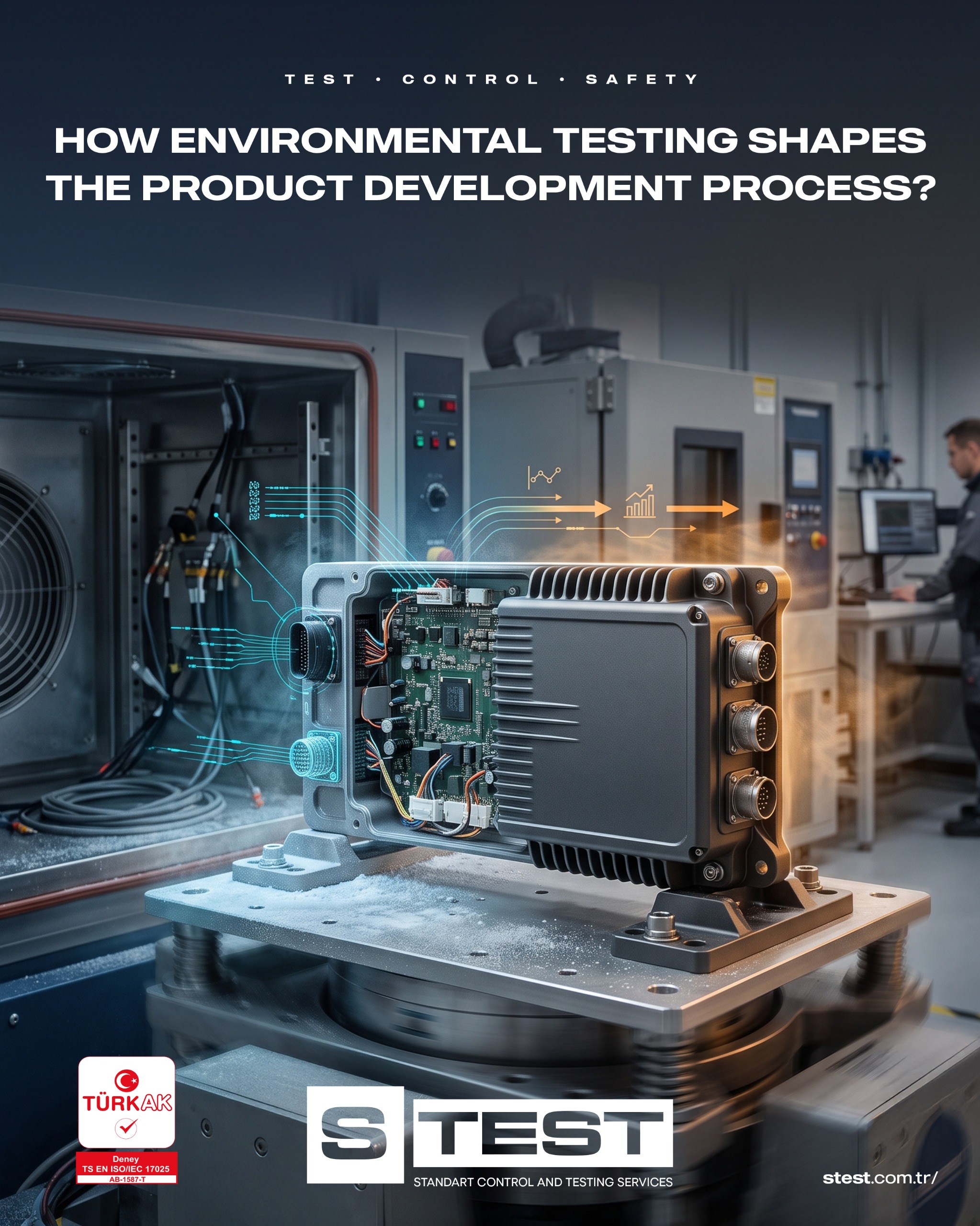
A product that performs successfully during the design phase does not necessarily deliver the same performance under real-world operating conditions. Products developed for the defence, automotive, aerospace, railway, and electronics industries are routinely exposed to demanding environmental conditions such as temperature fluctuations, vibration, humidity, mechanical shock, and other external stresses. For this reason, environmental testing is not merely a quality control activity but a fundamental component of the product development process.
Why are environmental tests so critical during product development? What happens when a product fails an environmental test? How do test results influence engineering and design decisions?
The Purpose of Environmental Testing Is Not Simply to “Pass” a Product, but to Evaluate Its True Performance
The primary objective of environmental testing is to evaluate a product under challenging operating conditions and accurately determine its actual performance. These tests allow potential design and manufacturing weaknesses to be identified within a controlled laboratory environment before the product reaches the field.
A well-executed environmental testing programme enables manufacturers to:
- Identify design deficiencies.
- Detect potential risks affecting critical components.
- Implement necessary design improvements before mass production.
- Prevent failures that could occur during field operation.
This approach not only improves product reliability but also helps reduce maintenance costs, warranty claims, and customer dissatisfaction.
Why Are Prototype Products Subjected to Environmental Testing?
Environmental testing is typically performed during the prototype or pre-production stages before mass manufacturing begins.
The reason is straightforward: resolving a design issue during product development is significantly more cost-effective than correcting the same issue after mass production has started.
For example, testing may reveal that:
- Electronic components generate excessive heat under elevated temperatures.
- A fastening element loosens during vibration testing.
- Protective coatings provide insufficient resistance during humidity exposure.
When such issues are identified at the prototype stage, engineers can revise the design to produce a more reliable and robust product before production is finalised.
Are Products Intentionally Pushed to Their Limits During Environmental Testing?
Yes. Certain environmental tests intentionally expose products to conditions beyond their normal operating environment. The objective is not to damage the product but to determine its safe operating limits.
Examples include:
- Higher-than-normal temperature levels.
- Extended vibration durations.
- Rapid temperature transitions.
- High-humidity conditions.
These evaluations help engineers identify the point at which product performance begins to degrade, allowing appropriate design margins and safety factors to be established.
The Most Common Causes of Environmental Test Failures
A failed environmental test does not necessarily indicate that a product is fundamentally defective. Instead, it identifies areas requiring engineering improvements.
The most common causes include:
- Inappropriate Material Selection
Incorrect material selection may result in deformation or performance degradation under high temperatures, low temperatures, or humid environments.
- Insufficient Mechanical Resistance to Vibration
Fasteners, structural supports, and mechanical assemblies may loosen or fail after prolonged vibration exposure.
- Electronic Component Issues
Solder joint cracks, connector failures, and cable damage are among the most frequently encountered issues during environmental testing.
- Inadequate Sealing Performance
Deficiencies in enclosure or gasket design may allow moisture, water, or dust to penetrate the product.
- Thermal Expansion Mismatch
Materials with different coefficients of thermal expansion may separate, crack, or deform during thermal cycling tests.
What Happens to Products That Fail Environmental Testing?
One of the most common questions regarding environmental testing concerns the condition of products after testing has been completed.
Not every tested product becomes unusable. The outcome depends on the specific test method and the applicable acceptance criteria.
Products That Successfully Pass Testing
Products that successfully complete testing while maintaining full functionality may be delivered to the customer and, where appropriate, used in subsequent verification or qualification activities.
Products That Do Not Meet Test Requirements
Products that experience performance degradation or physical damage during testing are also returned to the customer. However, these products are typically used for design reviews, failure analysis, and root cause investigations.
The information obtained from these analyses supports the development of improved product revisions with greater long-term reliability.
How Do Environmental Test Results Influence Product Design?
Environmental test reports provide far more information than a simple “pass” or “fail” outcome. They supply valuable engineering data that directly supports design optimisation.
Based on test results, engineers may:
- Select alternative materials.
- Reinforce structural connection points.
- Redesign cooling systems.
- Improve enclosure construction.
- Optimise printed circuit board layouts.
- Upgrade protective coatings.
These improvements enhance the product’s ability to withstand real operating environments while increasing overall reliability and service life.
Why Are Environmental Tests Critical Before Mass Production?
Implementing design modifications after mass production has begun can result in significant increases in cost, production delays, and additional engineering effort.
By contrast, environmental testing performed during product development provides substantial advantages by:
- Reducing design-related risks.
- Lowering manufacturing costs.
- Improving warranty performance.
- Minimising field failures.
- Increasing customer satisfaction.
- Supporting compliance with applicable national and international standards.
For these reasons, environmental testing is widely recognised as an essential part of modern product verification and validation processes across numerous industries.